
Print PDF, DWG, DWF, CGM, PLT, HPGL/2, and TIFF files
Printing and plotting with ViewCompanion
ViewCompanion provides many different printing options. These options include scaled printing, batch printing, n-up mode printing and poster mode printing. You may apply custom watermark, banner, header and footer to your printed document.
Both header and footer text are fully customizable, and you can include information as username, date, time, filename, page and the scale used for printing. Each header and footer can have up to 3 text lines.
For the watermark, or banner, you have full control of text content, rotation, font and color. You can decide whether the watermark should display below, or on top of the drawing.
An external image file, for example a JPEG file, may be used as a watermark instead of text.
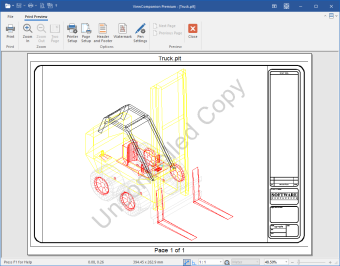
The picture to the right shows the full print preview of a drawing in ViewCompanion. In this preview you can see a watermark with the text "Uncontrolled Copy", as well as a header and footer with additional information. Click on the image for a larger view.
N-Up Printing
ViewCompanion do support n-up printing (for example 2-up, 4-up, etc.).
N-up printing, also known as multiple pages per sheet printing,
allows you to print two or more pages on the same sheet of paper.
The primary purpose of n-up printing is to reduce the number of pages that printed work would otherwise require.
N-up printing is popular in creating booklets, handouts, or draft prints. It reduces waste and costs, making it an
environmentally friendly option for large documents.
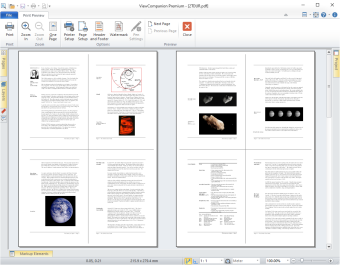
The picture to the right shows a preview of 4-up printing a multipage PDF file.
Click on the picture for larger view.
- 2-up → 2 document pages per sheet.
- 4-up → 4 document pages per sheet.
- 16-up → 16 document pages per sheet, and so on.
N-up printing is short for “Number-up printing”.
Poster Printing
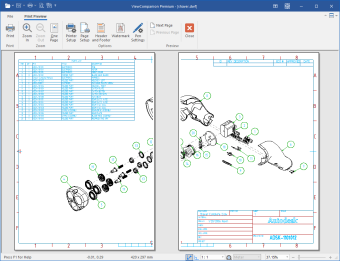
Poster mode printing is particularly useful when you need to print large-format drawings at full size using a standard printer with A4 or Letter-sized paper. Using poster mode, a large drawing is split across multiple smaller sheets that can later be assembled (taped or glued together) to form a full-size poster.
This makes it possible to print large drawings, banners, signs, and posters without requiring a wide-format printer — a standard home or office printer is sufficient.
Poster mode printing is also commonly known as tiled printing or mosaic printing.
Print Features
- Print to all Windows-supported printers and plotters.
- Print drawings and documents in full scale (1:1) or scaled-to-fit mode
- Support for poster/tiled printing of large drawings across multiple pages.
- Print documents in color, grayscale, or black-and-white mode.
- Add headers and footers containing information such as date, time, scale, and filename.
- Add text or image-based watermarks to printed output.
- Batch print multiple files in a single operation.
- Support for large paper sizes, custom page formats, and plotter devices.
ViewCompanion Information
ViewCompanion is available as three different editions: Standard, Pro and Premium.
Please refer to the individual product descriptions for detailed information:
ViewCompanion Standard
ViewCompanion Pro
ViewCompanion Premium
Download a 30-days trial now
You can learn more about the differences between ViewCompanion editions here.
Frequently Asked Questions
Which file formats can ViewCompanion print?
ViewCompanion can print and plot PDF, TIFF, CALS, DWF, DWFX, CGM,
HPGL, HPGL/2, PLT and several other technical document formats.
With ViewCompanion Premium, this support is extended to include DWG and DXF files.
Can I batch print multiple files?
Yes. ViewCompanion includes batch printing tools that let you print multiple files and folders automatically using predefined print settings.
Does ViewCompanion support poster or tiled printing?
Yes. Large drawings can be split across multiple sheets using poster printing, making it possible to print oversized documents on standard printers.
Can I add watermarks, headers, or footers when printing?
Yes. ViewCompanion can add watermarks, headers, and footers containing information such as filename, date, scale, and time during printing.
Can drawings be printed to scale?
Yes. ViewCompanion supports scaled printing and plotting, which is useful for CAD drawings, PCB layouts, and engineering documentation.
Does ViewCompanion support black and white or grayscale printing?
Yes. Documents can be printed in full color, grayscale, or black and white depending on your output requirements.


